
Skin Ageing Begins Beneath the Surface

Exploring the Emerging Science of UCMSC-Derived Exosomes

Skin ageing is a complex biological process influenced by intrinsic cellular changes and external environmental factors.


Although wrinkles, pigmentation, sagging and dryness are among the most recognisable signs of ageing, many underlying biological changes begin years before these features become apparent.

These Changes Include:

Reduced collagen & elastin production
Progressive deterioration of the extracellular matrix

Accumulation of oxidative stress

Alterations in cellular communication

Declining efficiency of tissue repair mechanisms

Changes in skin barrier function & hydration


Understanding these processes has encouraged researchers to explore new approaches to maintaining skin health.

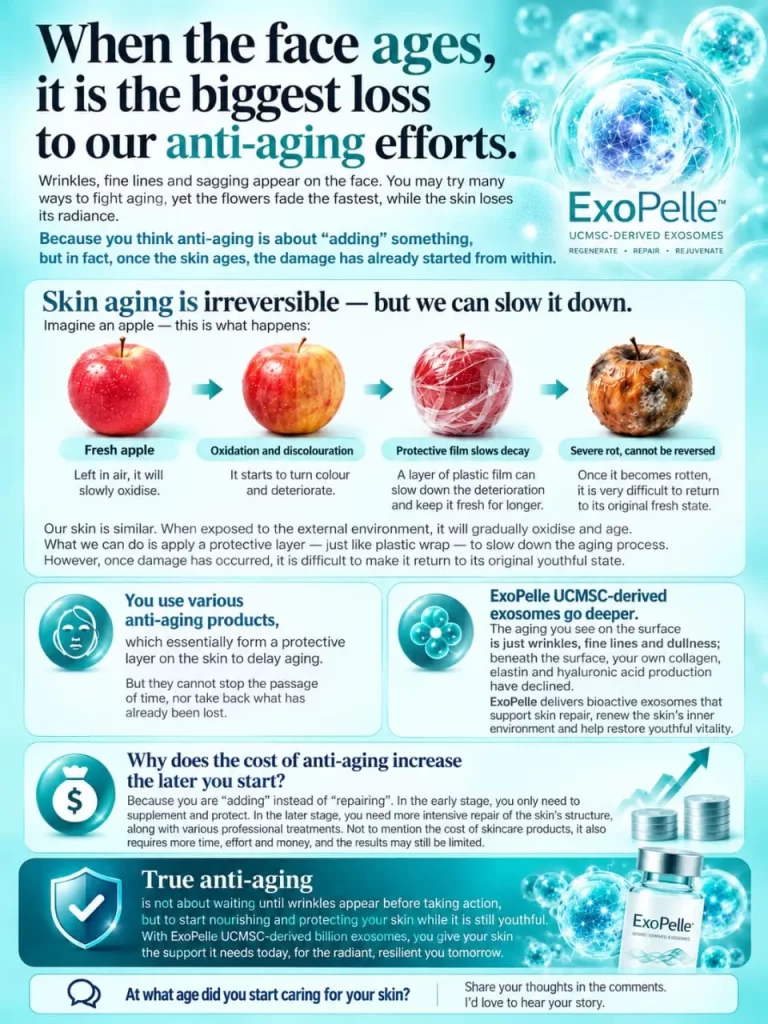
The Apple Analogy

Oxidation and Ageing

A freshly cut apple gradually discolours when exposed to oxygen. Although protective measures may slow this process, they cannot restore a severely deteriorated apple to its original condition.


This analogy helps illustrate one aspect of skin ageing: the cumulative effects of environmental exposure and oxidative stress.

However, unlike an apple, human skin is a living organ with ongoing cellular renewal, repair and adaptive mechanisms.


Skin ageing is therefore not simply an irreversible process of oxidation. It involves multiple biological pathways that may be influenced by preventive skincare, lifestyle and scientifically validated interventions.

These findings are promising, but they do not establish that every UCMSC-derived exosome formulation produces the same effects in human skin.


Clinical performance depends on factors such as source material, manufacturing, purity, particle characteristics, formulation, delivery method and dosage.

4. Tissue repair mechanisms

Preclinical studies have examined the role of extracellular vesicles in wound repair, cell migration and tissue regeneration.

3. Inflammatory signalling

MSC-derived vesicles have demonstrated immunomodulatory properties in experimental models, prompting interest in their potential relevance to skin homeostasis.

2. Oxidative stress responses

Experimental research suggests that certain extracellular vesicle preparations may influence cellular responses to oxidative stress.

UCMSC-Derived Exosomes

An Emerging Regenerative Approach

Umbilical cord mesenchymal stromal cells (UCMSCs) are being investigated as a source of extracellular vesicles for regenerative research.


Preclinical studies suggest that MSC-derived extracellular vesicles may influence several biological pathways relevant to skin ageing, including:

1. Fibroblast activity and extracellular matrix regulation

Laboratory investigations have explored the effects of MSC-derived vesicles on dermal fibroblasts and collagen-related signalling pathways.

Beyond Conventional Skincare

Traditional skincare products primarily address concerns such as hydration, barrier protection, pigmentation and visible signs of ageing.


Advances in regenerative biology have expanded scientific interest towards the communication networks that regulate tissue maintenance and repair.


One area attracting considerable attention is extracellular vesicle research.


Extracellular vesicles are microscopic membrane-bound particles released by cells. Some populations, including exosomes, contain proteins, lipids and nucleic acids involved in intercellular signalling.


Researchers are investigating whether these biological messengers could influence processes associated with skin health, including inflammation, extracellular matrix regulation and tissue repair.

The Role of Cellular Communication

Introducing ExoPelle™

Translating Regenerative Science into Aesthetic Innovation

ExoPelle™ represents an approach to regenerative aesthetic development centred on UCMSC-derived exosome technology.

Its scientific positioning draws on the emerging understanding of extracellular vesicles and their potential involvement in skin-related cellular signalling.


The development objective is to explore how appropriately characterised exosome preparations may contribute to future skin health and aesthetic applications.

Product-specific claims regarding collagen restoration, wrinkle reduction, skin rejuvenation or tissue repair require supporting evidence from relevant testing and controlled clinical studies.

Why Early Skin Care Matters

Preventive skin care remains one of the most practical strategies for maintaining skin health over time.

Daily Photoprotection

Daily Photoprotection

Avoidance of Smoking

Evidence-Based Dermatological Care

Emerging regenerative technologies may eventually complement these established measures, but should not replace them.

The Future of Regenerative Aesthetics

The next generation of aesthetic science is increasingly focused on understanding the biological mechanisms behind visible skin ageing.


Extracellular vesicle research represents an important area of scientific exploration, particularly in relation to cellular communication, inflammatory regulation and tissue maintenance.


As research progresses, rigorous characterisation, safety evaluation and well-designed clinical studies will be essential to translating laboratory findings into reliable aesthetic applications.

Scroll to Top